Zion weather, month by month
These are the National Park Service's own published averages rather than a forecast site's. The interesting part is not the numbers themselves but what they do to a day in a canyon fifteen hundred feet deep.
- Hottest month
- July, 100°F average high
- Coldest
- January and December, 30°F low
- Wettest
- February, 2.0 inches
- Driest
- June, 0.3 inches
Averages, from the park’s own chart
Averages are not forecasts. A July day can sit ten degrees either side of the figure below, and a February storm can drop far more than the month’s average in an afternoon. Use these to choose a month, then check an actual forecast in the week before you travel.
| Month | Average high | Average low | Precipitation |
|---|---|---|---|
| January | 54°F | 30°F | 1.8 in |
| February | 59°F | 34°F | 2.0 in |
| March | 66°F | 39°F | 2.0 in |
| April | 75°F | 45°F | 1.3 in |
| May | 86°F | 54°F | 0.7 in |
| June | 95°F | 63°F | 0.3 in |
| July | 100°F | 70°F | 1.2 in |
| August | 99°F | 68°F | 1.5 in |
| September | 91°F | 61°F | 1.0 in |
| October | 79°F | 48°F | 1.3 in |
| November | 64°F | 37°F | 1.4 in |
| December | 54°F | 30°F | 1.6 in |
What the chart does not say
The park’s chart gives no elevation and no period of record. Zion runs from around the canyon floor up to the high plateaus and the park itself notes that temperatures shift with elevation, so treat these as canyon figures and expect the high country to be markedly cooler. We are flagging that rather than converting the numbers ourselves.
A hundred degrees is not an abstraction here
July averages 100°F and August 99°F. Those are averages, so half the days are hotter.
What that does to a day in Zion is specific rather than general. The canyon walls hold heat and radiate it back, several of the best trails are paved and unshaded, and the popular ones face the wrong way in the afternoon. A hundred degree afternoon on the Watchman Trail, which the park notes has limited shade, is a genuinely bad idea.
The practical response is not to avoid summer. It is to move the day earlier. On the first canyon shuttle at 7:00am you have three or four usable hours before the heat arrives, and the middle of the day belongs to the river, which is the only reliably cool place in the park, or to shade at Zion Lodge.
Summer is also when June is the driest month of the year at 0.3 inches and the second half of the season is not. July and August bring 1.2 and 1.5 inches, and that difference is the monsoon.
The wettest months are not the dangerous ones
This is where reading a climate table wrongly gets people into trouble.
February and March look wet
Both average 2.0 inches, the highest of the year. That arrives as winter rain and snow spread across the month, mostly at temperatures where it is a nuisance rather than a hazard. It is why the paved trails hold ice and why the high roads close, and it is not what closes slot canyons.
July and August are the risk
1.2 and 1.5 inches, less on paper, delivered in violent afternoon storms that can drop a large part of a month’s total in an hour. That is what makes a narrow canyon lethal, and the rain that does it can fall miles away on ground you cannot see from where you are standing.
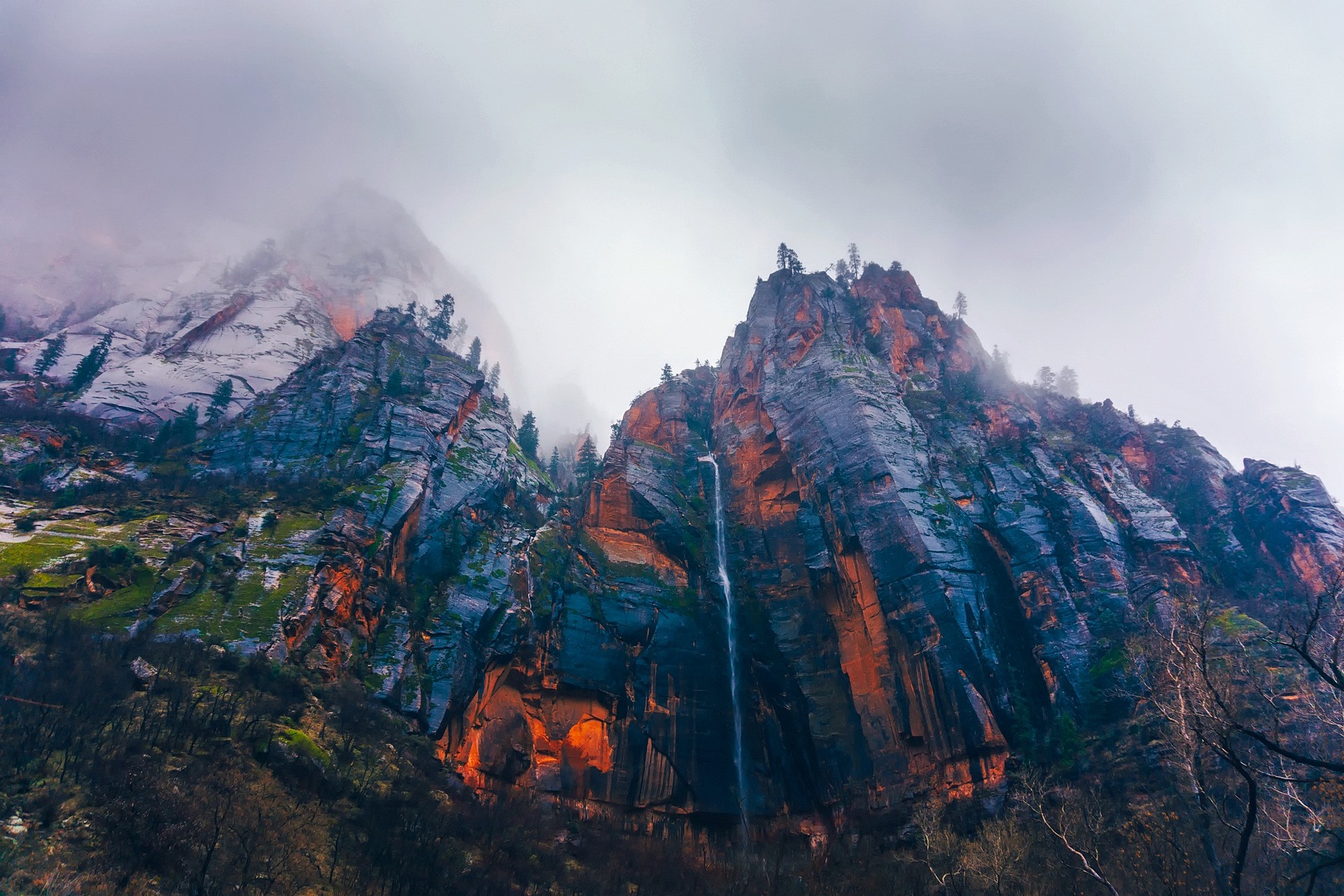
A dry sky above you means nothing in a slot
Flash floods in Zion come from rain upstream in the drainage, not from the weather overhead. The park publishes a flash flood potential rating and it is the number to read before The Narrows or any technical canyon in late summer, not the precipitation average on this page.
Day and night can differ by more than thirty degrees
That is the park’s own figure, and the monthly table shows it plainly.
| Month | High | Low | Gap |
|---|---|---|---|
| January | 54°F | 30°F | 24° |
| April | 75°F | 45°F | 30° |
| June | 95°F | 63°F | 32° |
| October | 79°F | 48°F | 31° |
An October afternoon at 79°F and an October dawn at 48°F are the same day. So are a June afternoon at 95°F and a June morning at 63°F. If you are on the 7:00am shuttle, which you should be, you are starting in the cold half of that gap and finishing in the hot half, and the canyon walls mean the sun arrives late and leaves early.
Layers, then. And in the shoulder months a warm layer that lives in the pack all afternoon and comes out the moment the light goes off the canyon floor.
What each month is actually like
| Month | The read |
|---|---|
| December to February | Highs in the fifties, lows around 30°F, the wettest months of the year. The shuttle mostly stops, so the scenic drive opens to cars, and the park is at its quietest. Ice on the paved trails. The winter guide. |
| March and April | Warming fast, 66°F to 75°F, and still among the wettest months. Snowmelt raises the river, which is what closes The Narrows in spring rather than rain. |
| May | 86°F and drying out at 0.7 inches. Arguably the best combination of weather and daylight in the year, which everybody else has also worked out. |
| June | 95°F and the driest month at 0.3 inches. Hot, but the monsoon has not started, so it is the most reliable month for slot canyons. Early June is noticeably quieter than May. |
| July and August | 100°F and 99°F with monsoon storms. The river is the only comfortable place. Start at seven or do not start. |
| September | 91°F falling away through the month, monsoon fading. The most popular month for good reason, and busy with it. |
| October | 79°F days and 48°F nights, cottonwoods turning. The best all round month if you can take the crowds, and the second half of November is the quiet version of it. |
| November | 64°F and thinning out. Shuttle service ends in late November and the trade for cooler days is a much emptier park. |
The fuller version of this decision, weighed against permits, water levels, crowds and what is actually open, is on best time to visit. This page is the raw numbers behind it.
Common questions about Zion weather
What is the hottest month in Zion National Park?
July, with an average high of 100 degrees Fahrenheit, closely followed by August at 99. Those are averages, so roughly half of summer days are hotter than that.
What is the coldest month in Zion?
January and December are level, both averaging a 54 degree high and a 30 degree low.
When does it rain most in Zion?
February and March, both averaging 2.0 inches. But the dangerous rain is in July and August, which average 1.2 and 1.5 inches delivered in violent afternoon storms rather than spread across the month.
What is the driest month in Zion?
June, averaging 0.3 inches. It is hot but the monsoon has not started, which makes it the most reliable month for slot canyons.
How much do temperatures change between day and night in Zion?
The park says they can differ by more than 30 degrees Fahrenheit, and the monthly averages bear that out. April, June and October all show gaps of 30 degrees or more between the average high and the average low.
What is the best month to visit Zion for weather?
May and October give the best combination of comfortable temperature and long daylight, at 86 and 79 degree average highs. Both are busy. Early June and the second half of November are the quieter versions.
Now pick the month for what you came for
The Narrows, canyoneering, Angels Landing and cycling all pull toward different weeks of the year.
Also useful: Zion in winter, Narrows conditions and which hikes work when.
July averages 100°F. Be on the 7:00am shuttle.
When to visit