Canyoneering tours you can actually book
The best thing you can do near Zion that most visitors never try. Also the trip people most often book with the wrong expectation, because of one rule nobody explains before you pay.
- Guided trips run
- Outside the park only
- Park canyons
- Self guided, permit required
- Price range
- $89 to $219 per person
- Best window
- Late September to October
No guide can take you canyoneering inside Zion National Park
The park does not permit commercial guiding on its technical canyon routes. As the region’s own tourism office puts it, guide companies are not permitted to access those routes, so you can only attempt them on your own.
Every guided canyoneering tour sold in and around Springdale runs on land outside the park boundary, mostly in the East Zion area. Those trips are genuinely good, the rock is the same Navajo sandstone, and for a first timer they are the better experience anyway.
The famous canyons inside the park, The Subway, Pine Creek, Mystery, Keyhole, are open to you only if you go self guided with a park permit and the skills to lead your own group down a rope. There is no version where you pay someone to take you.
Inside the park and outside it are two different activities
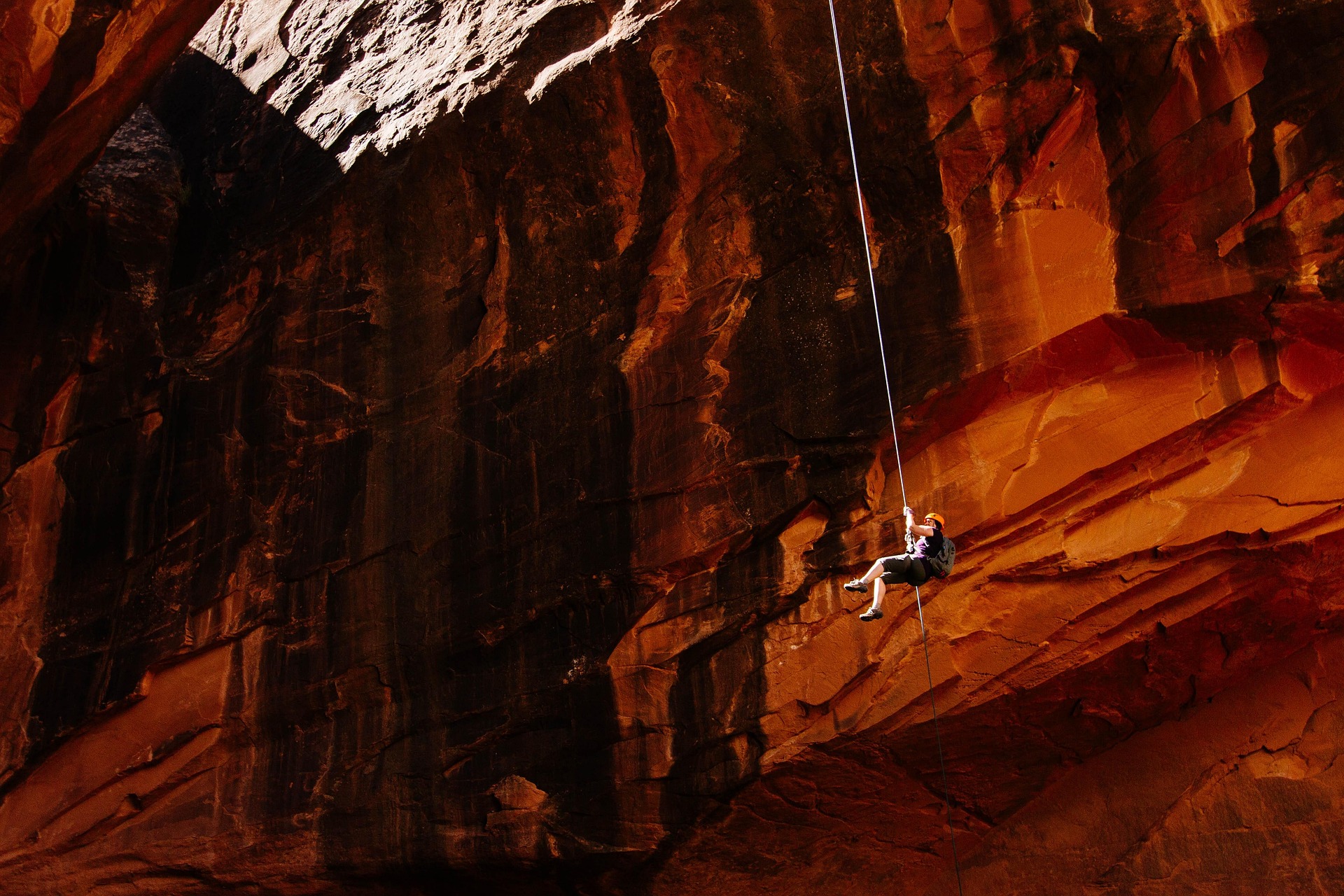
Search for canyoneering near Zion and you will find a dozen outfitters with photographs of people rappelling down glowing orange sandstone. Nothing about those pages is dishonest. But almost none of them lead with the fact that the canyon in the photo is not in the national park, and visitors routinely arrive believing they booked a trip into The Subway.
Guided, and open to beginners
Public and private land east and west of the park, plus state land further out. Guides are welcome here.
- Book a trip, show up, they supply the technical gear and the expertise
- No permit for you to chase, the outfitter handles access
- Trips from two hours to a full day
- Genuine slot canyons in the same rock formation
- Suitable for complete beginners, including families
This is where every guided canyoneering tour you can buy actually goes.
Self guided only, no exceptions
The named canyons that made Zion famous among canyoneers. No commercial guiding permitted on any of them.
- You need a park permit, and the popular ones go by lottery
- You need your own rope, harnesses, anchors and the skill to use them
- You need someone who can genuinely lead a technical descent
- Rescue is hours away and the canyons commit you once you start down
If nobody in your party has led a technical canyon before, this is not the year to start here.
Why the park restricts it
Zion’s technical canyons are narrow, they hold water, and they concentrate people at fixed rappel stations where a queue becomes a hazard. Limiting them to self guided permit holders caps the number of parties per canyon per day. It is a crowding decision rather than a judgment about guides, and several of the outfitters who cannot guide inside the park will happily teach you the skills to go in on your own.
What you can book, and roughly what it costs
These are the canyons the East Zion outfitters run, with published starting prices at the time of writing. Outfitters set their own rates and adjust them by season and group size, so treat every figure as a starting point and confirm when you book.
| Canyon | From | Time out | Level | Best for |
|---|---|---|---|---|
| Red Rock Slot | $109 | 2 hr | Intro | Young children, anyone testing whether they like it |
| Crimson Canyon | $119 | 2 hr | Intro | A short afternoon with a real rappel |
| Hidden Creek | $89 | 4 hr | Intro | Groups, best value on the list |
| Rock Drop Canyon | $149 | 3.5 to 4 hr | Intro | First timers who want more than a taster |
| Elkheart Canyon | $169 | 3 to 4 hr | Intro | The most commonly booked trip in the area |
| Coral Sands | $149 | 4 to 5 hr | Moderate | Reasonably fit adults, teenagers |
| Powell’s Way | $219 | 6 to 7 hr | Strenuous | A full day, multiple rappels, real commitment |
| Stone Hollow | $219 | 7 to 8 hr | Technical | The hardest guided option near Zion |
Two things worth noticing. The cheapest trip is not the shortest one, so compare on hours rather than headline price. And the jump from Coral Sands to Powell’s Way is much bigger than the fifty dollar gap suggests, because it is the difference between an afternoon and a committing full day in the sun.
Where these trips run
Most depart from the East Zion side, roughly forty minutes from Springdale over the Zion–Mount Carmel Highway, which is a spectacular drive in its own right and includes the mile long tunnel. A few outfitters run canyons west of the park instead, and Snow Canyon State Park near St George is a further option where guides are also permitted. Confirm the meeting point when you book, because a trip that meets in East Zion is a genuinely early start from a Springdale hotel.
How hard is it, really
The honest answer is that the rappelling is the easy part. Sitting back into a harness over an edge takes nerve the first time and about ninety seconds to learn. What actually tires people out is everything between the rappels.
One to three short rappels
Walking on sand and slickrock with some scrambling. If you can walk two miles on uneven ground you can do this. Most operators take children from around age five on the shortest trips.
Longer approach, more rope
More rappels and occasional downclimbing where you use your hands. Expect to be warm, dusty and pleasantly tired. Comfortable for most active adults and confident teenagers.
A full day out
A real approach, multiple rappels including longer drops, sustained movement over rock. You need to be genuinely fit and comfortable with heights by the end rather than just at the start.
The hardest guided trips
Long day, committing terrain, physical downclimbing and stemming. Guides will ask about your experience before confirming, and they are right to.
What guides actually assess
Ask any working canyon guide what makes a client hard to look after and almost none of them say fitness first. In order, the things that matter are:
- Willingness to be talked through fear. Being scared of the first rappel is normal and fine. Freezing and refusing to listen is the problem, and it usually resolves if you tell your guide you are nervous before you get to the edge rather than after.
- Honest self reporting. Knees, shoulders, a recent injury, how much you have actually walked this year. Guides plan around real information and cannot plan around a brave answer.
- Comfort in enclosed space. Slots get narrow. Not many people find this a problem, but the ones who do find out in the canyon, which is the worst place to find out.
- Basic fitness for the approach. The hike in, in heat, carrying nothing heavier than water, is what tires people.
If any of those give you pause, say so when you book rather than on the morning. Every outfitter here would rather move you to a shorter canyon than have a hard day with you in a long one.
The canyons inside the park, and how permits work
If you have the skills, this is the good stuff, and the permit system is more approachable than its reputation suggests. A permit is required for every canyon that needs rope or descending gear, for single day through hikes of The Narrows, and for every trip into the Left Fork of North Creek, which is the drainage people mean when they say The Subway.
| Canyon | Character | How to get a permit |
|---|---|---|
| The Subway (Left Fork) | Strenuous, semi technical | Seasonal lottery |
| Mystery Canyon | Fairly strenuous, technical | Seasonal lottery |
| Pine Creek | Fairly strenuous, technical | Advance reservation or daily lottery |
| Keyhole Canyon | Short, technical | Advance reservation or daily lottery |
| Orderville Canyon | Strenuous, semi technical | Advance reservation or daily lottery |
| Echo Canyon | Fairly strenuous, technical | Advance reservation or daily lottery |
| Behunin Canyon | Strenuous, technical | Advance reservation or daily lottery |
| Spry Canyon | Strenuous | Advance reservation or daily lottery |
| Misery Canyon | Strenuous, technical | Advance reservation or daily lottery |
Three ways to get one
Seasonal lottery
For the Left Fork and Mystery Canyon only. Applications open two months before each three month season. You pick up to four dates and rank them. Results go out on the 27th and winners have two weeks to claim. $6 non refundable to apply.
Advance reservation
Everything else. Opens up to three months ahead on a seasonal basis and stays open until 5:00pm Mountain Time the day before your trip. If you are organized, this is the route. $6 non refundable per reservation.
Daily lottery
The last minute option. Apply two days before, between 12:00am and 3:00pm Mountain Time. One application per person per day, up to four canyons on it. Drawing at 4:00pm. $6 non refundable to apply.
On top of the application fee there is a $10 per person charge that is refundable. If everything is claimed, walk in permits are sometimes available same day at the Zion Canyon Visitor Center when spaces remain. That is a genuine option midweek in shoulder season and close to hopeless on an October Saturday.
Be realistic about your own skills
A permit is an administrative document. It confirms you have a slot, not that you can do the canyon. Zion’s technical routes involve fixed anchors, rope work, downclimbing and, in several canyons, cold water you have to swim. Every year people rappel off the end of a rope that was too short for the drop. If nobody in your group has led a technical canyon, take a skills course with a Springdale outfitter first. That is exactly what those courses exist for.
Permit rules, fees and season windows change. Check the current position on the National Park Service canyoneering permits page before you plan around anything here, and see our Zion trip planning guide for how the permit calendar interacts with the rest of your week.
Best time to go canyoneering near Zion
Canyoneering has a genuinely different season profile from hiking, because the things that make a canyon good, water and shade, are also the things that make it dangerous at the wrong time of year.
| Season | Conditions | Verdict |
|---|---|---|
| March to May | Spring runoff. Canyons that hold water are cold and pushy. Dry canyons are excellent. Comfortable air temperatures. | Good for dry slots, wetsuit weather for wet ones |
| June to mid July | Hot and dry. Approach hikes are the hard part. Canyons themselves stay shaded and pleasant. | Good, start early |
| Mid July to mid Sept | Monsoon season. Afternoon thunderstorms build fast, often over ground you cannot see from the canyon. | Highest flash flood risk of the year |
| Late Sept to October | Storm pattern breaks, temperatures drop, light gets low and warm in the slots. | The best window of the year |
| November to February | Cold. Short days. Water sections become a serious proposition and some canyons ice up. | Dry canyons only, guided options thin out |
If you have flexibility, come in the first three weeks of October. If you are coming in August, book a morning trip rather than an afternoon one and read the next section properly.
For how canyoneering fits around everything else, see the best time to visit Zion and our three day Zion itinerary.
Flash floods, honestly
Every canyoneering page mentions flash floods. Most mention it the way an airline mentions the seat belt sign. It deserves better than that, so here is the real version.
A slot canyon is a drain, and the storm that fills it can be miles away over ground you never drove past.
It collects water from a catchment you cannot see from inside it. The canyon does not need to be raining in for the water to arrive. When it does arrive it comes as a surge carrying sand, logs and rock, in a corridor with vertical walls and nowhere to climb.
What happened at Keyhole Canyon
On September 14, 2015, a party of seven picked up a canyoneering permit at 7:40 in the morning for Keyhole Canyon, a short technical slot inside the park. At 2:22 that afternoon the National Weather Service issued a flash flood warning, and the park closed its canyons to canyoneering the same hour. The group was already inside. The flood came through between roughly 4:30 and 5:30pm. All seven died.
The lesson is not that they were reckless. It is that a permit issued in the morning tells you nothing about the afternoon, and once you are committed in a slot you cannot act on new information. This is why guides cancel trips on days that look fine from the parking lot, and why you should be pleased rather than annoyed when yours does.
The rating system, and how to use it
The park publishes a flash flood potential rating each day. The four levels are worth knowing by name, because the gap between the middle two is where people make bad calls.
| Rating | What the park means by it |
|---|---|
| Not expected | Flash flooding is not expected. Your safety is still your responsibility. |
| Possible | Some slot canyons, dry washes and small streams may flood. |
| Probable | Some slot canyons, dry washes and small streams are expected to flood. |
| Expected | Many slot canyons, dry washes and small streams are expected to flood. |
Monsoon season runs roughly mid July to mid September. During it, the park closes slot canyons outright when conditions warrant, and in recent years has done so more than once a season.
Warning signs, if you are already in
- Building storm clouds anywhere on the horizon, not only overhead
- The water changing colour, going muddy or red
- An increase in debris, sticks and floating vegetation
- A rise in water level, however small
- A sound like wind or a distant engine with no wind
If a flood does come, the park’s guidance is blunt and correct: abandon your gear and get to high ground immediately. Equipment is replaceable and the two seconds spent unclipping a pack is the entire margin.
Why we are telling you this rather than selling around it
discoverspringdale.com compares trips, it does not operate them, and we have no commercial reason to talk you into a canyon on a bad day. A guide who cancels on you is doing their job. Book with the outfitter, not against the weather.
What to bring on a guided trip
Your outfitter supplies everything technical: harness, helmet, ropes, rappel devices, and a wetsuit if the canyon holds water. What you bring is the ordinary stuff, and getting it wrong is what makes people uncomfortable rather than unsafe.
Bring
- Closed toe shoes with grip you do not mind ruining. Trail runners or approach shoes. Not sandals, not brand new white sneakers.
- More water than feels necessary. Two to three litres for a half day, more in summer.
- Synthetic or wool layers. Cotton stays wet and cold once you have been in water.
- Sun protection. The approach is exposed even when the canyon is not.
- Snacks, more than you think, especially on the six hour trips.
- A small dry bag for a phone if the canyon has water in it.
Leave behind
- Anything you would be upset to scratch. Sandstone eats sunglasses, watches and camera bodies.
- Loose jewellery and long unsecured hair. Both find their way into a rappel device.
- Daypacks with dangling straps. They snag in narrow sections.
- Cotton hoodies and jeans. Heavy when wet, cold, slow to dry.
- Any expectation of phone signal. There is none in the canyons.
If you need to buy or rent anything before the trip, Springdale’s outfitters carry it and are used to last minute visitors. See gear rental in Springdale.
Which trip suits you
Family with young children
Red Rock Slot or Crimson Canyon. Two hours, one short rappel, plenty of sand to play in while the group takes turns. Some operators take children from around age five, and at least one advertises a trip suitable from age one for the walking portion. Confirm minimum ages directly, because they vary by canyon and by outfitter.
First timers, no head for heights
Rock Drop or Elkheart. Long enough to feel like a real trip, short enough that a nervous first rappel does not define your whole day. Tell the guide before you start, not at the edge. Almost everybody who is scared on the first rappel is grinning by the third.
Fit adults wanting a real day
Powell’s Way or Stone Hollow. Six to eight hours, multiple rappels, committing terrain and the feeling of having actually been somewhere. This is the closest guided equivalent to the inside the park experience. Expect a conversation about your experience before they confirm.
If your heart is set on The Subway
Then your path is a skills course, not a tour. Book a two day canyoneering course with a Springdale outfitter, learn anchors and rope management properly, then enter next season’s lottery for the Left Fork. It is a longer road and it is the only legitimate one, and the people who take it tend to describe the eventual trip as the best day they have had in Utah.
Common questions about canyoneering near Zion
Can I book a guided trip into The Subway or Pine Creek?
No. Commercial guiding is not permitted on Zion’s technical canyon routes. Those canyons are open to self guided parties holding a park permit. Any tour advertised near Zion runs outside the park boundary.
Do I need any experience?
Not for the intro and moderate trips. Guides teach you to rappel at the first drop and most people have it within a couple of minutes. The strenuous and technical canyons are different, and outfitters will ask about your background before confirming those.
Can children go canyoneering?
Yes, on the shorter canyons. Minimum ages vary by trip and outfitter, with some intro trips taking children from around age five and at least one very short option advertised for younger children. Confirm the age limit for the specific canyon when you book rather than assuming from a general policy.
Will I get wet?
It depends entirely on the canyon. Many East Zion slots are dry most of the year. Canyons that hold water are usually run with a wetsuit supplied by the outfitter. Ask when booking if staying dry matters to you, because it changes which canyon you want.
Is it safe?
Guided canyoneering with a reputable outfitter has a strong safety record, and the technical systems are managed by your guide. The two real hazards are flash floods, which is why trips get cancelled on unsettled days, and heat on the approach hikes in summer. Both are managed by going with people who know the ground and by not pushing a guide to run a canyon they have called off.
What if I am afraid of heights?
Very common and usually not disqualifying. The rappels on intro canyons are short and you are on a rope the guide controls. Tell them at the trailhead so they can put you where they want you in the order and talk you through the first one. If you genuinely cannot go over an edge, ask about canyons where the rappels can be bypassed.
How far in advance should I book?
In spring and fall, a week or two for a specific canyon and date. In midsummer and around holidays, longer. Same week availability does turn up, particularly midweek, so it is always worth asking.
Is it worth the money?
If you have never rappelled, yes, straightforwardly. A hundred to two hundred dollars buys a half day doing something most visitors to Zion never do, in terrain they never see, with someone who knows it. If you have canyoneered before and were hoping for the famous park canyons, the guided options will feel modest, and your money is better spent on a skills course.
Find the right canyon for your group
We compare every canyoneering outfitter working near Springdale, what each one runs, who they suit and what they charge, so you can pick on something better than a photograph.
Planning the rest of the trip? Start with the Zion planning guide, check how the shuttle works, or read up on The Narrows and the Angels Landing permit lottery.
Ready to book? Compare every canyoneering outfitter near Springdale.
Compare outfitters